Review at a Glance
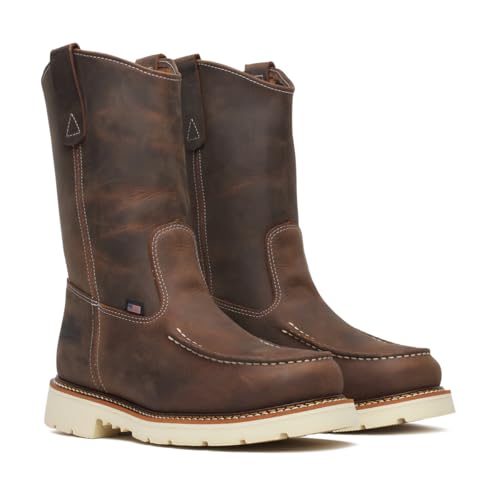
| Product | BRUNT Marin Welted (Comp Toe) - Men’s Size 8.5, Dark Tan - 8" Waterproof Safety Toe Wedge Work Boot |
|---|---|
| Price | |
| Best For | Tradespeople who want a resoleable, waterproof 8-inch composite-toe boot and who are unsure whether they need a D or EE width |
| Key construction | Resoleable Goodyear welt construction |
| Safety ratings claimed | ASTM F2413-24 M I/75 C/75 EH; ASTM F1677-96 Mark II and ASTM F2913-19 SATRA non-slip standards |
Disclosure: We earn a small commission from qualifying Amazon purchases at no extra cost to you.
As an Amazon Associate, we earn from qualifying purchases.Last Updated: September 2026
Look, most 8-inch composite-toe work boots are cemented units: when the outsole wears through, the boot is trash. That single construction choice is the reason this particular BRUNT model deserves a careful read of its spec sheet rather than a glance at the photos.
This is a specifications review. Nobody on this website wore these boots, walked a jobsite in them, or put a caliper on the welt. What follows is a close reading of what BRUNT publishes on the Amazon listing for this exact size-8.5 Dark Tan configuration, plus what those published figures plausibly mean for a buyer standing on concrete, a slab, or a barnyard floor all day.
Supported strengths
- Goodyear welt construction that BRUNT describes as resoleable, which is what extends a boot's service life past its first outsole.
- A non-metallic composite safety toe that the manufacturer states does not conduct heat or cold and is 15% lighter than steel.
- Waterproof membrane plus waterproof, barnyard-resistant FARMGUARD leather.
- SWITCH-FIT adjustable width: remove the gray insert to go from regular (D) to relaxed (EE).
- Outsole that BRUNT rates oil and slip-resistant and high-heat resistant up to 572 degrees.
- The supplied listing information does not state a boot weight, a shaft circumference, a heel height, or a break-in expectation.
- No puncture-resistant plate is listed in the published ASTM designation, so this is not the boot for a site where sole puncture protection is specified.
- The listing does not state a warranty length, an insulation rating, or a temperature rating for cold-weather work.
- No aggregate customer rating or review count was supplied with this product record, so this review cannot speak to owner consensus.
Quick Picks
| Product | Best for | What the listing establishes | Link |
|---|---|---|---|
| BRUNT Marin Welted (Comp Toe) - Men’s Size 8.5, Dark Tan - 8" Waterproof Safety Toe Wedge Work Boot | A resoleable, waterproof, width-adjustable composite-toe wedge boot for heavy-duty jobsites | Goodyear welt construction described as resoleable; composite toe rated ASTM F2413-24 M I/75 C/75 EH; FARMGUARD waterproof leather; SWITCH-FIT D-to-EE width change | Check Price on Amazon |
Only one product record was supplied for this page, so this table has one row. A single-row comparison is more honest than a table padded with models whose specifications we do not have in front of us.
Overview: What the Listing and Specifications Show
The BRUNT Marin Welted (Comp Toe) - Men’s Size 8.5, Dark Tan is an 8-inch waterproof safety-toe wedge work boot built on Goodyear welt construction, with a non-metallic composite toe and a built-in adjustable width system. Those four things — height, waterproofing, welt, adjustable width — are the spine of the whole product.
BRUNT's own framing is that the welt is there "to extend the overall life of the boot" and that the Marin 8" Welted is "built for heavy-duty jobsites." Read that as a durability-and-repairability pitch rather than a lightweight-athletic pitch.
Here's the thing about a resoleable boot: the value proposition only pays off if you actually intend to get it resoled. A Goodyear welt stitches the upper and insole to a welt strip that the outsole attaches to, so a cobbler can remove and replace the outsole without destroying the upper. If your habit is to buy new boots every season and never visit a repair shop, you are paying for a capability you will not use — and a cheaper cemented boot may serve you just as well.
The wedge outsole designation in the product name matters too. Wedge soles, with their flat full-contact profile and deep lug pattern, are traditionally favored on flat surfaces like slabs, decking, roofs and shop floors. BRUNT states the outsole has "extra-deep outsole lugs for extra traction," which is consistent with that use case, though the listing does not publish a lug depth figure or a ladder-grip specification.
Key Features and Specifications
| Specification | What BRUNT publishes on the Amazon listing |
|---|---|
| Construction | Resoleable Goodyear welt construction |
| Shaft height | 8 inches (per product name) |
| Safety toe | Non-metallic composite; does not conduct heat/cold; 15% lighter than steel |
| Outsole | BRUNT rubber; oil and slip-resistant; high-heat resistant up to 572 degrees; extra-deep lugs |
| Waterproofing | Waterproof membrane plus waterproof, barnyard-resistant FARMGUARD leather |
| Chemical resistance | Leather resists the damaging effects of harsh chemicals; outsole and midsole meet ASTM D471-06 903 oil and isooctane chemical resistant standards |
| Insole | Triple Layer BRUNT Cush'n: nonstick top layer, memory foam midlayer, cushy bottom layer, anti-odor treatment |
| Support | Lightweight nylon shank; triple-padded collar |
| Width system | BRUNT SWITCH-FIT; remove gray insert to change from regular fit (D) to relaxed fit (EE) |
| Lacing | Pass-through/wrap-around lace hooks; heavy-duty eyelets |
| Safety standards claimed | ASTM F2413-24 M I/75 C/75 EH; ASTM F1677-96 Mark II; ASTM F2913-19 SATRA non-slip |
| Size/color in this record | Men's 8.5, Dark Tan |
Everything in that table comes from BRUNT's published listing content for this ASIN. Fields you do not see — weight, warranty, insulation, country of manufacture, last shape, puncture plate — were not in the supplied record, which means they are unknown here, not absent from the product.
Decoding the ASTM designation
The published string is ASTM F2413-24 M I/75 C/75 EH. Broken down using the standard's own convention: M indicates the footwear is rated for men, I/75 is impact resistance at the 75 level, C/75 is compression resistance at the 75 level, and EH is electrical hazard. That combination is the common baseline for safety-toe boots on construction and industrial sites.
What is not in that string is just as important. There is no PR (puncture resistance), no Mt (metatarsal guard), no CD (conductive) and no SD (static dissipative) designation published for this model. If your site's PPE requirement calls for a puncture-resistant plate or a met guard, this boot as listed does not document those protections.
On the EH rating specifically, preserve the scope: EH footwear is designed as secondary protection against incidental contact with live circuits, not as a substitute for de-energizing equipment or for primary electrical PPE. The rating also assumes the boot is dry and intact; worn-through outsoles and embedded metal debris undermine it.
The listing also cites ASTM F1677-96 Mark II and ASTM F2913-19 SATRA non-slip testing. Those are slip-resistance test methods, and the claim here is that the boot meets them — a manufacturer's conformance claim, not an independent audit published in the listing.
Expected Performance, Based on Manufacturer and Listing Data
No performance figures were observed on this website. What follows is inference from BRUNT's published specifications, and it should be read as inference.
Heat near the sole. BRUNT rates the rubber outsole as high-heat resistant up to 572 degrees. That is an outsole material rating, not a permission slip: it says nothing about upper performance, about how long contact can be sustained, or about foot temperature inside the boot. Roofers working hot asphalt and welders dealing with spatter are the buyers most likely to care, and they should still confirm their employer's specific heat-exposure requirement rather than treating a single outsole figure as full coverage.
Cold and heat conduction at the toe. The manufacturer states the composite toe does not conduct heat or cold. In practice that usually means less of the toe-numbing cold-sink effect you get from a steel cap in winter. It is not an insulation claim, and the listing publishes no insulation or temperature rating for the boot overall.
Weight. BRUNT says the composite toe is 15% lighter than steel. Note the scope carefully: that is a comparison of the toe cap, not of the finished boot against a competitor's finished boot. The supplied record does not state the boot's weight, so nobody can honestly call this a light boot or a heavy one.
Wet work. A waterproof membrane plus waterproof FARMGUARD leather is a belt-and-suspenders approach to keeping water out. BRUNT also calls the leather barnyard-resistant, which is the language brands use for resistance to manure and the acids and alkalis that come with livestock work. Reasonable inference: this is a plausible pick for dairy, ranch and landscaping work as well as general construction. No immersion depth or hydrostatic rating is published, and an 8-inch boot is still open at the top — water over the collar gets in regardless of membrane.
Underfoot comfort. The Triple Layer BRUNT Cush'n insole combines a nonstick top layer, a memory foam midlayer and a cushy bottom layer with anti-odor treatment. Layered memory-foam insoles are generally aimed at long standing shifts. There is no published figure for stack height, density or durometer, so how the cushioning holds up over months is not something this record can establish.
Torsional support. The lightweight nylon shank is the stiffening element between heel and forefoot. Nylon shanks are chosen when a brand wants support without the weight or electrical conductivity of steel — which is consistent with an EH-rated, non-metallic-toe boot. Again, inference from material choice, not a measured stiffness value.
Build Quality and Design
Judging from materials and construction listed rather than from any physical inspection, the spec sheet reads like a mid-to-upper-tier work boot rather than a disposable one.
The Goodyear welt is the headline. Welted construction is slower and more expensive to manufacture than cementing or direct-attach injection, and BRUNT explicitly ties it to extending the boot's overall life through resoling. That is the single most consequential design decision in this product.
The upper is FARMGUARD leather that BRUNT describes as waterproof and barnyard-resistant, with resistance to the damaging effects of harsh chemicals. Pair that with the outsole and midsole meeting ASTM D471-06 903 oil and isooctane chemical resistance standards, and the picture is a boot specified for environments with oils, fuels and agricultural waste.
Smaller details worth noticing: a triple-padded collar, which BRUNT says helps stabilize, protect and cushion the ankle, and pass-through/wrap-around lace hooks with heavy-duty eyelets. Wrap-around hooks let you cinch the upper shaft quickly and lock the heel down — useful on an 8-inch boot where the lacing run is long.
The SWITCH-FIT width system
This is the feature I would highlight for anyone who has struggled to buy boots online. BRUNT's SWITCH-FIT is a built-in gray insert: leave it in for a regular D fit, pull it out for a relaxed EE fit.
For a size 8.5 buyer, that is genuinely practical. Smaller sizes are often the hardest to find in multiple widths, and a single SKU that covers D and EE reduces the odds of an exchange. What the system does not do is create a narrow (B) or extra-wide (4E) option, and the listing does not state how the removable insert affects insole stack height or volume once removed. If you need a width outside D–EE, this does not solve your problem.
Value for Money
Prices move, so check the current price on Amazon before deciding. What can be assessed here is where the cost is going.
You are paying for three things that cost real money to build: Goodyear welt construction that BRUNT describes as resoleable, a waterproof membrane layered with waterproof FARMGUARD leather, and a published ASTM F2413-24 M I/75 C/75 EH rating with documented slip and chemical resistance conformance. Those are not cosmetic features.
The resoleability argument only converts to value if you use it. A welted boot whose upper survives two or three outsoles has a very different cost-per-year than the same money spent on a cemented boot. Before you bank on that, confirm with a local cobbler that they will resole this model — the supplied listing information does not state a resoling service, cost, or a number of times the boot can be resoled.
What you are not paying for, based on the published record: a puncture-resistant plate, a metatarsal guard, or any stated insulation. Buyers who need those features are shopping in a different spec bracket.
Who Should Buy This
Strong fit:
- Trades on flat surfaces — concrete slabs, decking, shop floors, roofs — who want a wedge outsole with extra-deep lugs and an oil and slip-resistant rubber compound.
- Anyone working around livestock, manure, oils or fuels, where barnyard-resistant FARMGUARD leather and ASTM D471-06 903 oil and isooctane chemical resistance for the outsole and midsole are directly relevant.
- Buyers who want a non-metallic toe because it does not conduct heat or cold and is 15% lighter than steel per BRUNT.
- Size 8.5 buyers uncertain between a D and an EE width, who would otherwise gamble on a return.
- People who actually use a cobbler and want the resoleable Goodyear welt to pay off over years.
- Your site mandates puncture resistance or a metatarsal guard — neither appears in the published ASTM designation for this model.
- You need documented insulation for sustained cold work; no insulation or temperature rating is stated in the supplied listing information.
- You need a width narrower than D or wider than EE.
- You want a soft-toe boot; this configuration is the composite safety toe version.
How We Research
This website does not perform product research, and this page is no exception. The method for this review was narrow and specific:
- Pull the verified product record for ASIN B0DWXZ7FXT from the Amazon Creators API, retrieved 2026-09-08, to confirm the exact model, size and colorway being reviewed.
- Read every published listing feature bullet for that ASIN in full, rather than summarizing the title.
- Separate manufacturer claims ("ultra-durable," "next-level comfort") from verifiable specifications (ASTM designations, the 572-degree outsole rating, the 15% toe weight comparison).
- Decode the cited standards and state their scope limits, so an EH rating is not mistaken for primary electrical protection and a toe-cap weight comparison is not mistaken for a boot weight.
- Flag every field the supplied record does not contain instead of filling it from memory.
Frequently Asked Questions
BRUNT states the boot is engineered with resoleable Goodyear welt construction to extend the overall life of the boot. The listing does not state how many times it can be resoled or name a resoling service, so confirm with a cobbler before counting on it.
What ASTM rating does this boot carry?
The listing states it meets ASTM F2413-24 M I/75 C/75 EH, plus ASTM F1677-96 Mark II and ASTM F2913-19 SATRA non-slip testing standards. No puncture resistance or metatarsal designation is published for this model.
Is it actually waterproof?
BRUNT describes a waterproof membrane combined with waterproof, barnyard-resistant FARMGUARD leather. That is a strong specification for wet and dirty work, but no immersion depth or hydrostatic figure is published, and water entering over an 8-inch collar will get in regardless.
How does the adjustable width work?
The BRUNT SWITCH-FIT system uses a built-in gray insert: leave it in for a regular D fit, remove it for a relaxed EE fit. It does not provide widths outside that D-to-EE range.
Is a composite toe as protective as steel here?
For this model the composite toe is rated at the I/75 and C/75 impact and compression levels under ASTM F2413-24, which is the same protection class commonly specified for steel. BRUNT adds that the non-metallic toe does not conduct heat or cold and is 15% lighter than steel.
Will this boot handle hot surfaces?
BRUNT rates the rubber outsole as high-heat resistant up to 572 degrees. Treat that as an outsole material rating only — it does not establish a duration of contact, an upper rating, or any foot-temperature claim, and you should match it against your employer's specific heat-exposure requirement.
How much does the size 8.5 weigh?
The supplied listing information does not state a weight for this boot. The only weight-related figure published is that the composite toe is 15% lighter than steel, which is a toe-cap comparison rather than a finished-boot weight.
Final Verdict
Buy this one if you intend to keep it. The BRUNT Marin Welted (Comp Toe) - Men’s Size 8.5, Dark Tan is specified as a resoleable Goodyear-welted, waterproof, EH-rated composite-toe wedge boot, and that combination is aimed squarely at a tradesperson who wants a boot to outlive its first outsole rather than a cheap annual replacement.
The two features that do the most work for a buyer are the resoleable welt and the SWITCH-FIT D-to-EE width adjustment. The first changes the long-term math; the second meaningfully lowers the risk of ordering footwear online in a size where width options are often thin.
Where I would hold back: if your jobsite requires puncture resistance, a metatarsal guard, or documented insulation, the published specification for this model does not cover you. And because no weight, warranty or owner-rating data came with this record, a buyer who wants those answers should check the live listing before ordering.
Sources and Methodology
Nothing on this page came from wearing the boot — this website ran no wear trial, no slip test and no laboratory work, and does not operate a lab. The review is built from the Amazon Creators API verified product record for ASIN B0DWXZ7FXT retrieved 2026-09-08 and from that listing's own feature bullets, cross-read against the public scope of the standards BRUNT cites, with background on consumer product safety from the U.S. Consumer Product Safety Commission and USA.gov consumer protection. For safety footwear that is a more useful foundation than it sounds: construction method, leather and membrane specification, and the exact ASTM designation are the facts that determine whether a boot is legal for your site and repairable over years, and all three are published rather than experiential — while fit, break-in and long-term cushioning are not, and this page does not pretend to answer them.